

Showing Up as My Whole Self—Blue Hair and All
By Dr. Gulshan N. Salim, Psy.D. | Licensed Psychologist | Trauma Therapy for High-Achieving Adults in New York
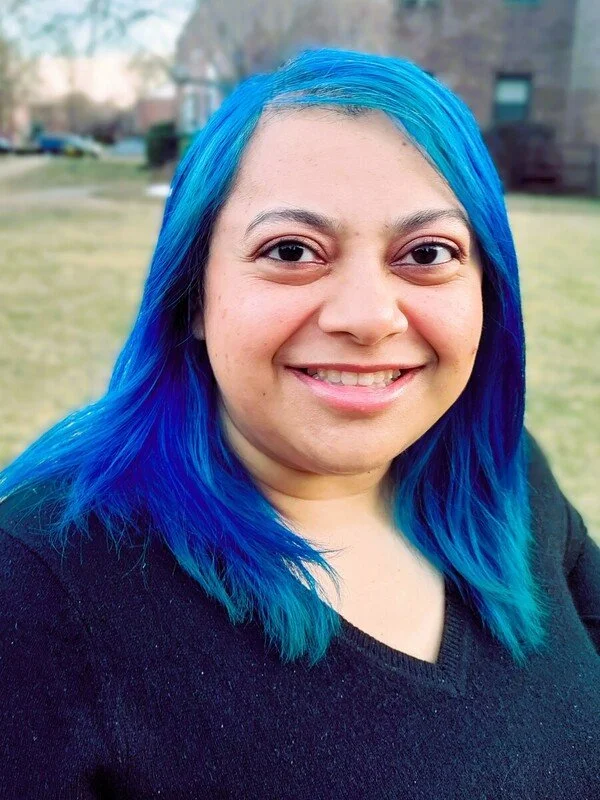
Showing up fully — blue hair and all. | Photo by Dr. Gulshan N. Salim, Psy.D.
I’m going to let you in on something. The blue hair wasn’t a branding decision. It wasn’t a social media strategy or a way to stand out in a crowded field. It was something much quieter and more personal than that.
It was the first time in a long time that I let myself want something just because I wanted it.
The Color I Always Wanted
I’d wanted blue hair since I was a kid. For years, I talked myself out of it. I went with comic book red first—bold, yes, but somehow still within the bounds of what felt permissible. Blue felt like too much. Too visible. Too me.
When I finally did it, I realized something I now talk about with my patients all the time: the things we’ve been quietly denying ourselves often carry more weight than we know. Saying yes to the blue hair wasn’t just about color. It was about reclaiming something I’d been told—implicitly, repeatedly—wasn’t appropriate for someone who wanted to be taken seriously.
That moment of permission? That’s what healing can look like.
When Therapists Show Up Fully
There’s a history of therapy spaces feeling cold, clinical, and deliberately blank—the idea being that an emotionally neutral therapist creates a cleaner mirror for the patient. I understand the theory. But I’ve never believed it’s the whole story.
The people I work with—high achievers, creatives, deep thinkers—have often been in therapy before. They know the language. They can perform insight in their sleep. What they’re actually looking for isn’t someone who stays perfectly neutral. It’s someone who is genuinely present.
Real connection—the kind that actually moves something—often starts with the unspoken: the warmth in someone’s voice, the cozy hoodie on a Tuesday afternoon, the blue hair on the screen. These aren’t distractions from the therapeutic relationship. For the right patient, they’re the beginning of it.
Does It Actually Matter How Your Therapist Shows Up?
Yes—and research bears this out. The therapeutic alliance (the quality of the relationship between therapist and patient) is consistently one of the strongest predictors of good outcomes in therapy, cutting across different modalities and approaches.
Alliance is built through things like:
• Feeling genuinely heard, not just processed
• Sensing that your therapist is actually curious about you, not just executing a technique
• Experiencing consistency between what your therapist says and how they carry themselves
• Feeling safe enough to bring the parts of yourself you've never shown anyone
The blue hair is one small signal in that larger story. It says: I’m not performing a role here. This is who I actually am.
What Therapy With Me Actually Looks Like
You won’t find a rigid persona here, or what I sometimes call the “therapist voice™”—that measured, slightly removed tone that can make you feel like you’re being studied rather than met.
What you will find is a space where you’re invited to bring your full self—messy, brilliant, guarded, hopeful, hurting. I’ll meet you there, not from above it. We’ll work with evidence-based tools and warm curiosity to move through what’s been holding you back toward what’s actually possible.
My approach to trauma therapy—including the method I call Haunted House Therapy™—is built on the belief that healing doesn’t mean erasing your edges or conforming to a mold. Sometimes it looks like coloring outside the lines. Sometimes it looks like finally being seen.
You can read more about how I work on my Approach page, or learn more about why I built this practice and what I believe about trauma on my Understanding PTSD & C-PTSD page.
Showing Up Is Where It Starts
Whether you’ve been in therapy before or you’re considering it for the first time, the question worth sitting with isn’t am I bad enough to need this. It’s: is there a version of my life where I feel more like myself?
If the answer is yes—or even maybe—that’s worth exploring. And I’d be honored to explore it with you.
Curious about whether this feels like the right fit?
I offer a free 30-minute consultation—no pressure, no obligation. Just a real conversation.
You are not broken. You are becoming whole.®
— Dr. Gulshan N. Salim, Psy.D.
